Seeing Through Multiple Views: Parameter-Efficient Fine-Tuning via Selective Neurons for Consistent Radiology Report Generation
Abstract
Radiology report generation from multi-view chest X-rays remains challenging because most existing methods directly fuse visual features across views. This often ignores view-specific behaviors inside the model and may lead to inconsistent findings across frontal and lateral studies.
To address this, the paper proposes View-PNDF, a parameter-efficient framework that studies report generation from a neuronal perspective. Instead of updating the whole model, View-PNDF identifies view-sensitive neurons, verifies whether they truly encode view-specific patterns, and then selectively fine-tunes only those neurons to improve report consistency and clinical reliability.
The framework further uses large language models to consolidate view-specific reports into a complete radiology report, and demonstrates strong gains on benchmark radiology report generation tasks while preserving robust general-view performance.
Key Contributions
- Neuron-level view modeling: The paper reframes multi-view radiology report generation through the lens of view-specific neurons rather than only feature fusion.
- View-PNDF framework: It introduces a three-part pipeline with view-specific neuron detection (VND), verification (VNV), and fine-tuning (VNF).
- Parameter-efficient adaptation: Only detected view-specific neurons are updated, reducing computational overhead while preserving view-agnostic knowledge.
- Better view consistency: The method improves report quality for different chest X-ray views and supports more reliable integrated reporting.
Method Overview
View-PNDF is designed for consistent multi-view radiology report generation. The core idea is that a vision-language model for report generation contains neurons that respond differently to frontal and lateral chest X-rays. If these neurons can be found and selectively adapted, the model can become more view-aware without expensive end-to-end retraining.
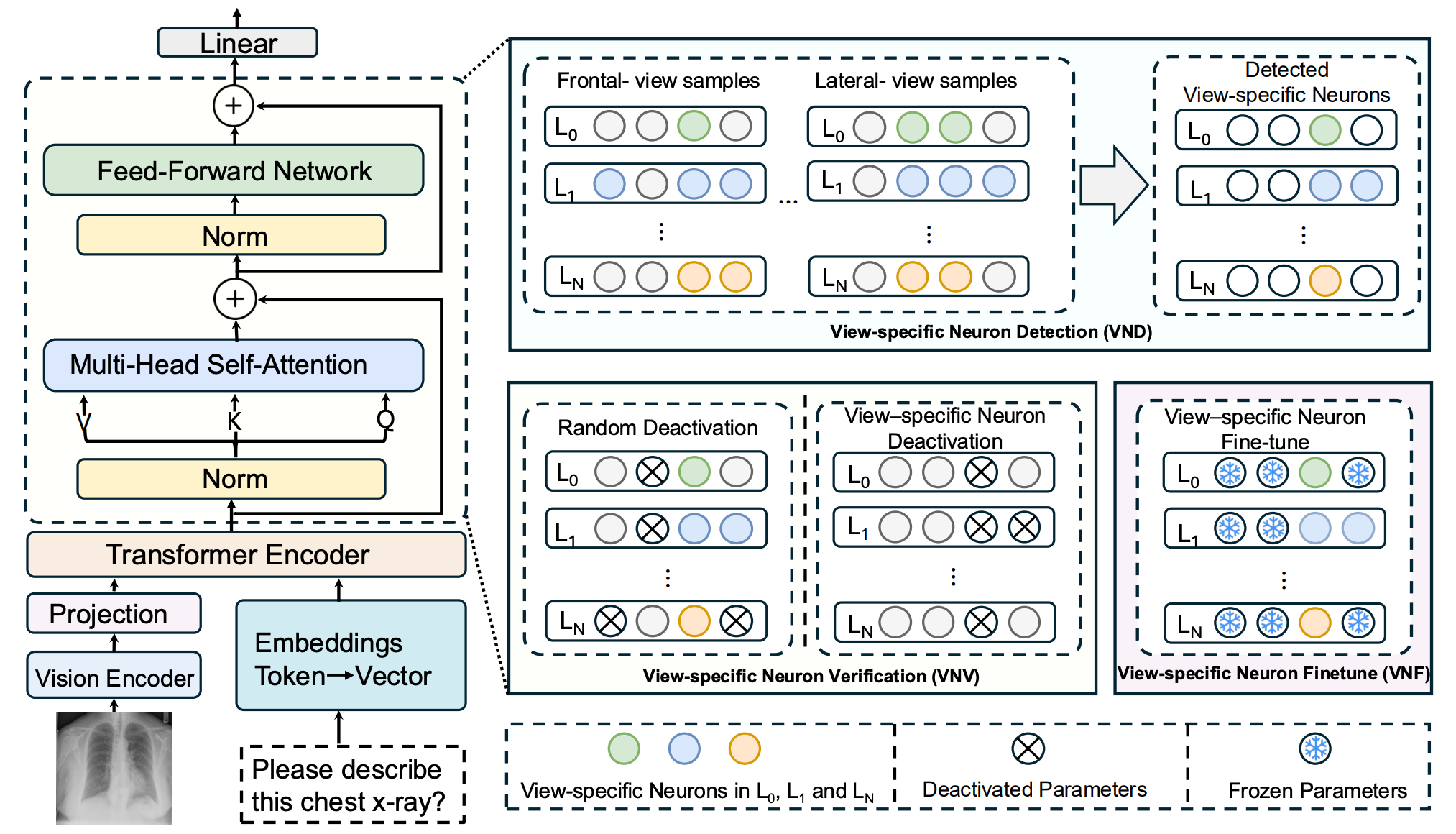
The full framework contains three key modules:
- VND: detects neurons that react strongly to a particular chest X-ray view.
- VNV: validates whether these neurons indeed encode view-specific patterns rather than noise.
- VNF: selectively fine-tunes those neurons for report generation while retaining view-agnostic representations.
This structure gives the model a cleaner balance between specialization for each view and shared medical knowledge, which is especially useful when generating consistent findings across multi-view studies.
Results & Ablation
The paper evaluates View-PNDF on benchmark radiology report generation settings and shows that neuron-level selective tuning can improve view-specific reporting quality without sacrificing the broader performance of the base model.
A particularly important part of the study is the ablation analysis on MIMIC-CXR, which examines whether the proposed detection, verification, and fine-tuning pipeline is genuinely necessary.
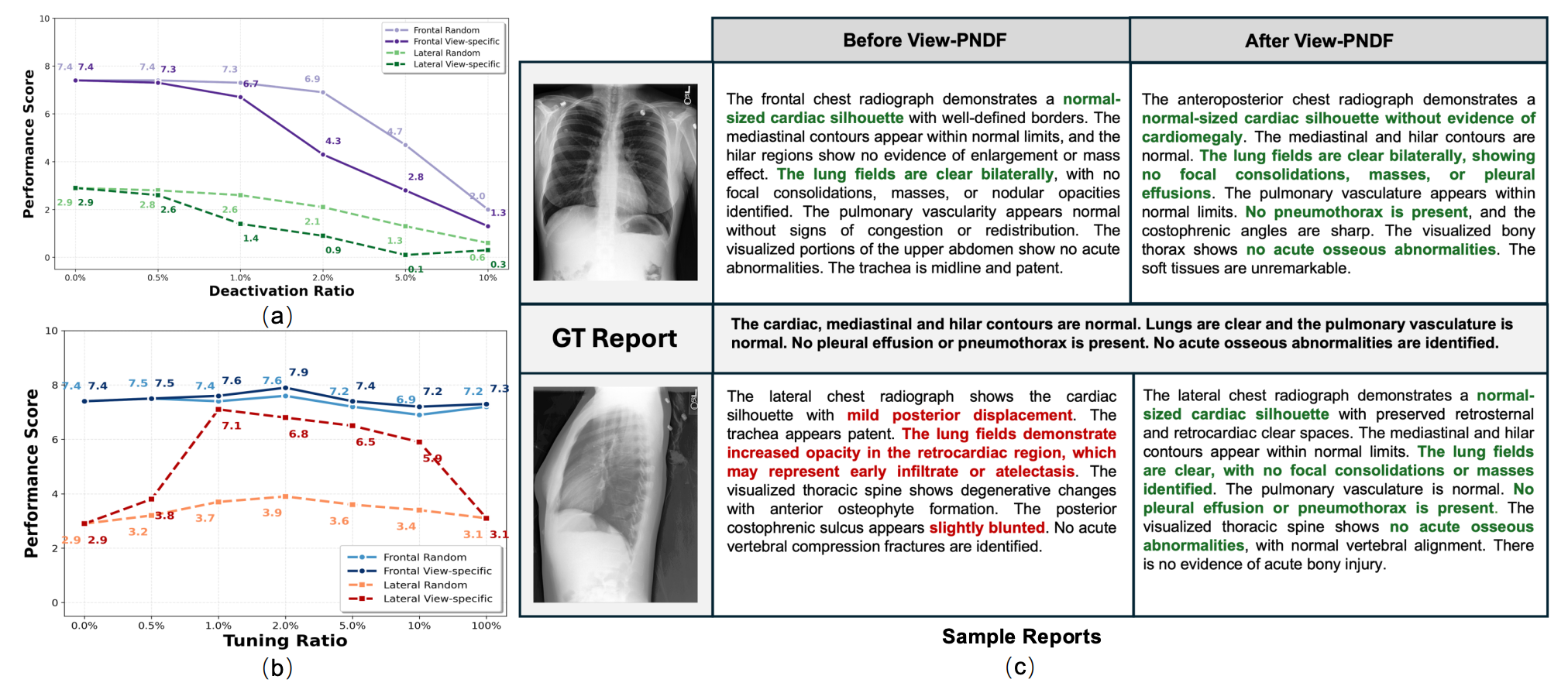
These results support three main findings: the detected neurons are not random, the fine-tuning strategy benefits harder lateral-view generation in particular, and the final model produces more consistent view-specific reports that are easier to integrate into a coherent final report.
Citation
@misc{chen2026viewpndf,
  title={Seeing Through Multiple Views: Parameter-Efficient Fine-Tuning via Selective Neurons for Consistent Radiology Report Generation},
  author={Chen, Yucheng and Zhu, Jinjing and Yu, Yang and Shi, Yufei and Naghshbandi, Hane and Liu, Jinhua and Koh, Angela S. and Fen, Fang and Ong, Kian Eng and Yeo, Si Yong},
  year={2026},
  eprint={2606.31099},
  archivePrefix={arXiv},
  primaryClass={cs.CV},
  doi={10.48550/arXiv.2606.31099},
  note={Accepted by MICCAI 2026}
}
Accepted by MICCAI 2026
Medical Image Computing and Computer Assisted Intervention