Causal-augmented Source-free Domain Adaptation with Scale-free Transformer for Schizophrenia Classification
Abstract
Multi-site schizophrenia classification from resting-state fMRI faces a practical adaptation challenge: source-domain data are often unavailable during deployment due to privacy and data-sharing constraints. Source-free domain adaptation (SFDA) addresses this setting by adapting a pretrained source model to an unlabeled target domain without revisiting source data, but this requires robust feature extraction and effective target-domain regularization.
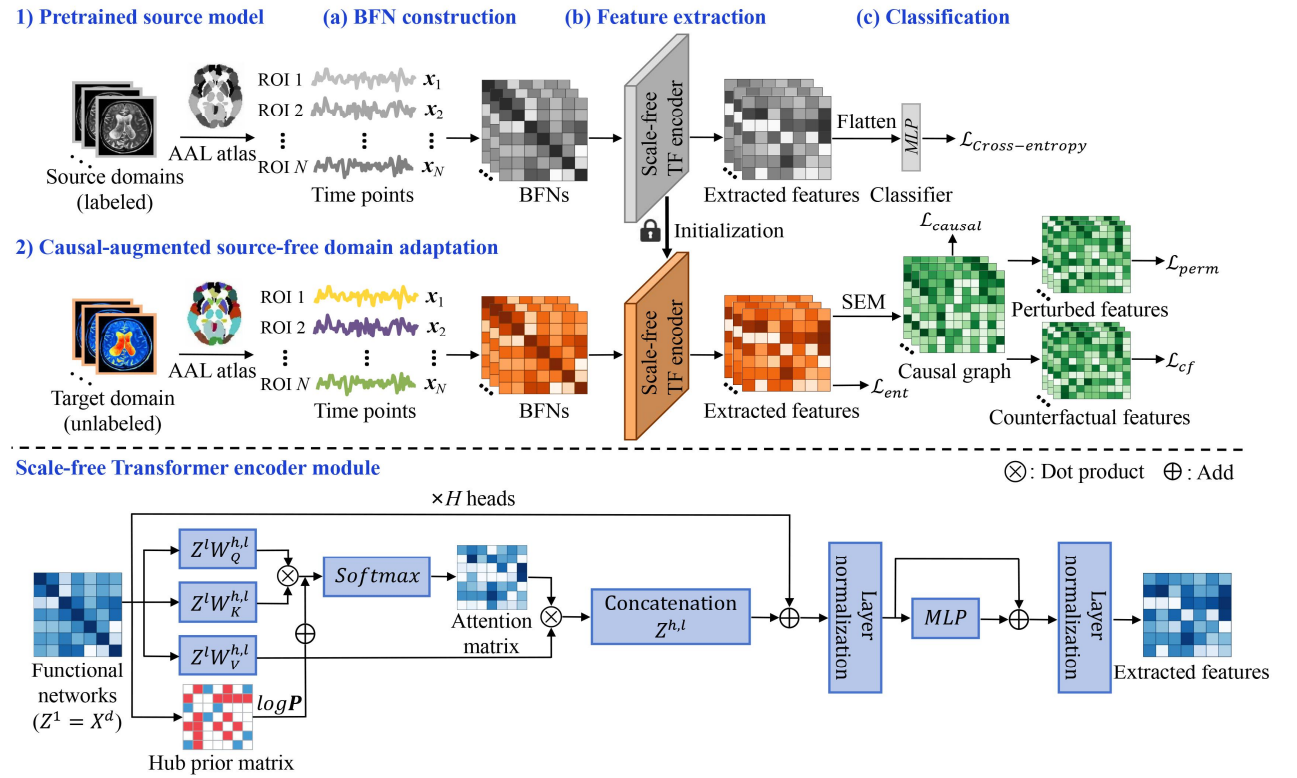
We propose a two-stage framework for schizophrenia classification based on brain functional networks (BFNs). In Stage 1, a scale-free transformer is pretrained on labeled source-domain BFNs. Its attention mechanism is guided by a scale-free prior that biases attention toward high-degree hub nodes, reflecting the topology commonly observed in functional brain networks and improving discriminative feature learning. In Stage 2, the pretrained encoder and classifier are transferred to the unlabeled target domain for source-free adaptation.
To improve robustness under target-domain shift, we introduce a causal-augmented adaptation strategy. Latent representations are used to construct causal graphs, which are then perturbed through random permutation and counterfactual interventions to produce diverse augmented views. Together with entropy minimization, these augmentations encourage more stable target-domain decision boundaries.
Experiments on FBIRN and BSNIP show that the proposed method achieves strong target-domain performance, reaching 87.18%±0.91% and 88.39%±0.13% accuracy, respectively.
Key Contributions
- A source-free domain adaptation framework for multi-site schizophrenia classification that adapts to unlabeled target domains without revisiting source-domain data.
- A scale-free transformer encoder that incorporates a scale-free prior into self-attention, emphasizing high-degree hub nodes in brain functional networks.
- A causal-augmented adaptation strategy that constructs causal graphs from target-domain latent features and generates augmented views through random permutation and counterfactual intervention.
- A joint optimization scheme combining causal augmentation and entropy minimization to improve robustness and target-domain generalization.
Method Overview
The framework operates in two stages. In Stage 1, BFNs constructed from resting-state fMRI across multiple source sites are used to train a transformer encoder and classifier. A scale-free prior is injected into the attention mechanism so that the encoder focuses more strongly on hub-like regions, which are important for global information integration in functional brain networks.
In Stage 2, the pretrained encoder and classifier are transferred to an unlabeled target site under the source-free domain adaptation setting. The encoder extracts latent features that are used to construct causal graphs. These graphs are perturbed by random permutation and counterfactual intervention to generate diverse target-domain augmentations. Entropy minimization is further applied to encourage confident target predictions. Together, these components improve robustness to target-domain distribution shift without requiring access to source data.
Results & Performance
The proposed framework was evaluated under a multi-site adaptation setting on two independent schizophrenia datasets, FBIRN and BSNIP. The method was compared against multiple transformer variants and domain adaptation baselines, with classification accuracy measured on the target site.
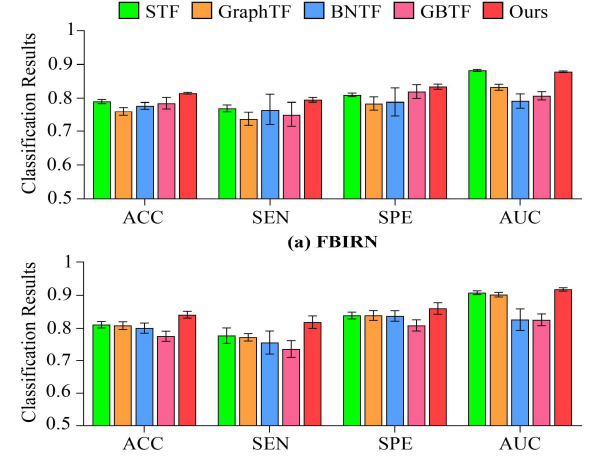
Figure 3 presents the ablation study across target domains. The results show that the scale-free prior, causal graph construction, random permutation, counterfactual intervention, and entropy minimization each contribute positively to the final performance.
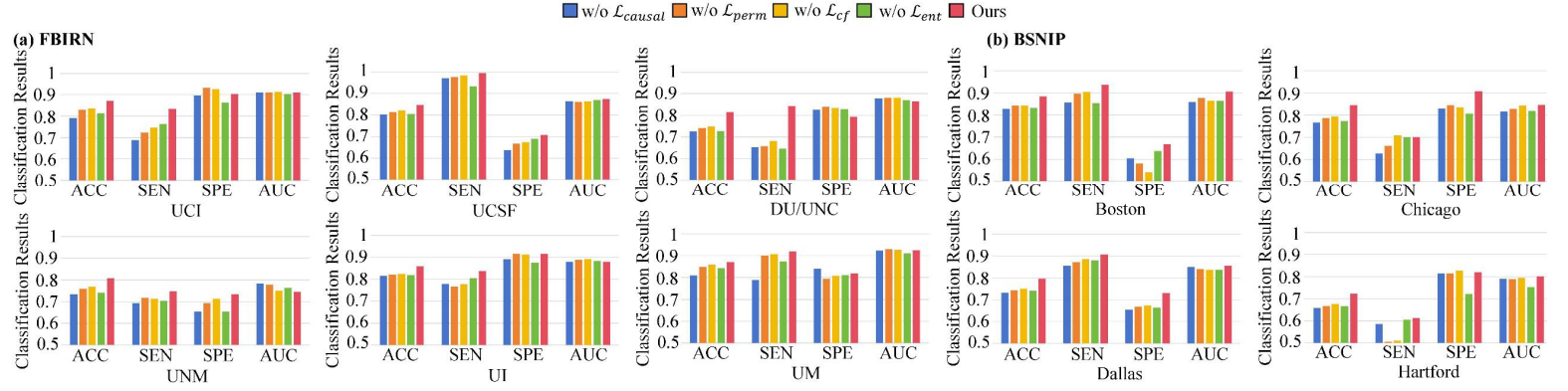
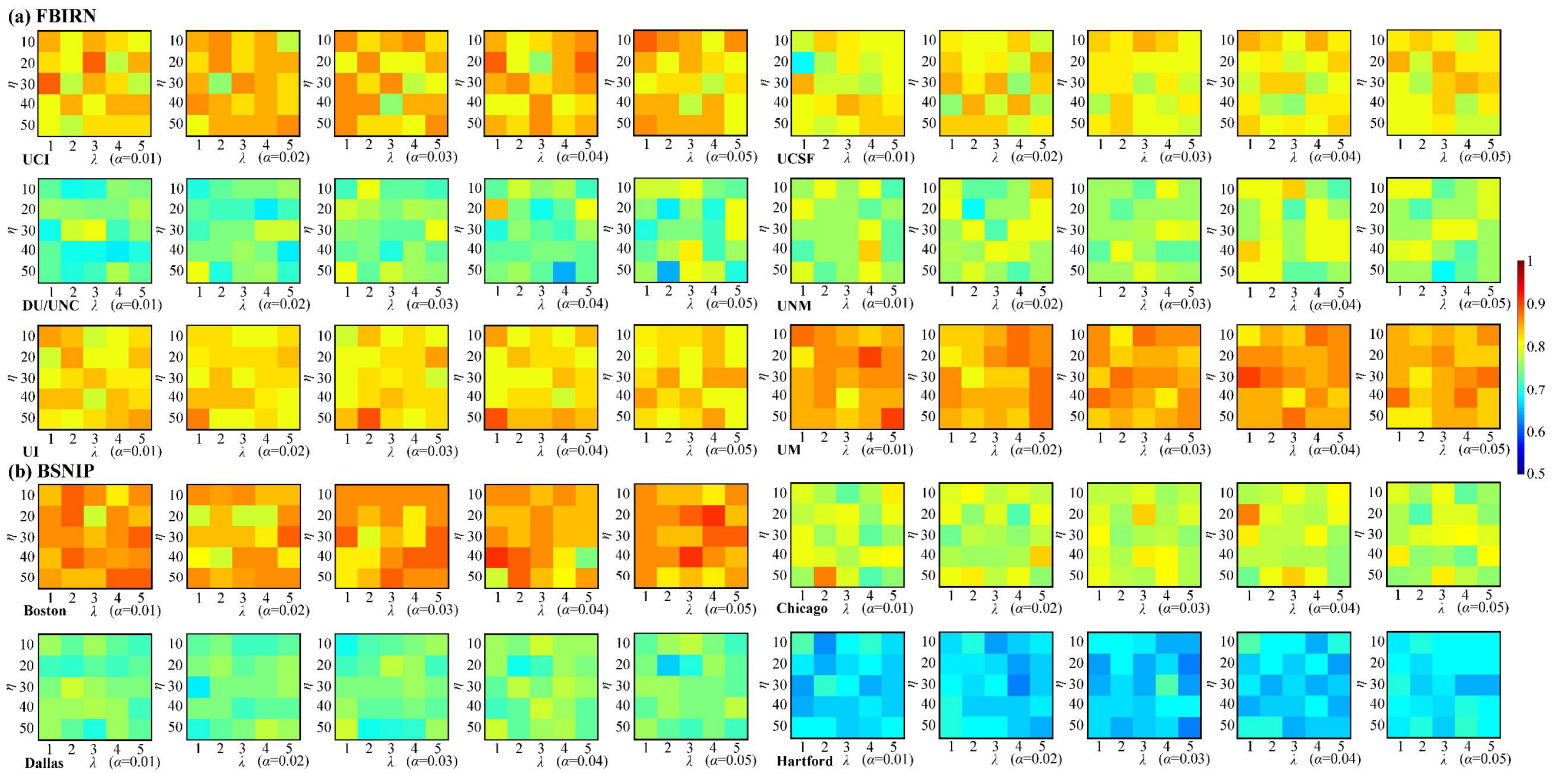
Figure 4 shows parameter sensitivity across target sites. The method remains stable over a broad range of hyperparameter settings, indicating good robustness in practical adaptation scenarios.
On the two benchmark datasets, the proposed framework achieved 87.18%±0.91% accuracy on FBIRN and 88.39%±0.13% accuracy on BSNIP.
Citation
@article{ji2026causal,
  title={Causal-augmented Source-free Domain Adaptation with Scale-free Transformer for Schizophrenia Classification},
  author={Ji, Yixin and Calhoun, Vince D and Zhu, Qi and Xia, Zhengwang and Zhang, Jin and Li, Shengrong and Van Erp, Theo G M and Mathalon, Daniel H and Yeo, Si Yong and Qi, Shile and Zhang, Daoqiang},
  journal={IEEE Transactions on Neural Systems and Rehabilitation Engineering},
  year={2026},
  doi={10.1109/TNSRE.2026.3676767},
  publisher={IEEE}
}